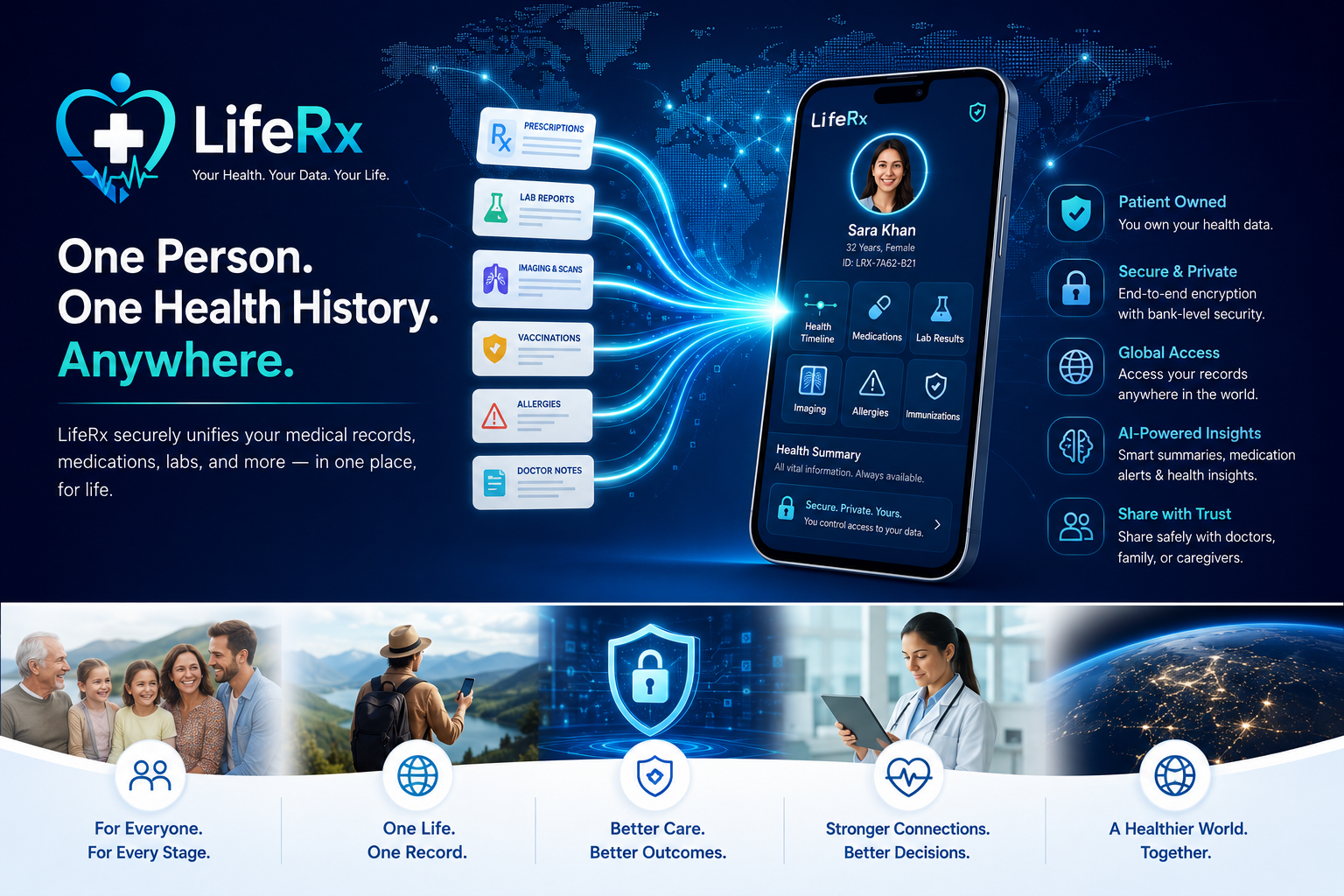
LifeRx – The World's Personal Health Memory
A patient-owned AI health record that gives every person on Earth a secure, lifelong medical history in one place.
Posted by Haiqa Arif Ansari
Healthcare data is fragmented. Medical records, prescriptions, lab reports, vaccinations, imaging results, allergies, and treatment histories are scattered across hospitals, clinics, pharmacies, and personal devices. As people move between cities, countries, doctors, and healthcare systems, critical information is often lost, duplicated, or inaccessible when needed most.
LifeRx aims to solve this global problem by creating a patient-owned digital health memory that follows individuals throughout their lives.
Users can upload prescriptions, lab reports, scans, vaccination records, and other medical documents. AI automatically extracts and organizes the information into a simple, easy-to-understand health timeline. The platform can track medications, identify potential drug interactions, summarize health history, and generate emergency medical profiles that can be accessed instantly when needed.
The vision is to give every person on Earth ownership of their complete health story, regardless of where they live or receive care.
The Problem:
Every person on Earth has health information scattered everywhere:
- Prescriptions
- Lab reports
- Vaccination records
- Medical imaging
- Allergies
- Doctor notes
- Emergency contacts
- Wearable data
People change doctors, cities, hospitals, and countries. Records get lost.
Every year, patients:
- Repeat expensive tests
- Forget medications
- Miss important health changes
- Experience medication errors
- Receive delayed treatment during emergencies
This is a global problem affecting virtually everyone.
The Solution:
- LifeRx creates a single lifelong health memory owned by the patient.
- Users upload any medical document, photo, prescription, or lab report.
AI automatically:
- Extracts information
- Builds a timeline of health events
- Tracks medications
- Flags drug interactions
- Summarizes health history
- Creates emergency medical cards
The patient—not the hospital—owns the record.
Why This Is Different:
Most healthcare apps focus on:
- Fitness
- Appointments
- One hospital system
LifeRx focuses on the person.
Imagine being able to travel anywhere in the world and instantly share a complete medical history with a doctor.
Who is it for?
- Patients and families
- Elderly individuals managing multiple medications
- Travelers and expatriates
- Healthcare professionals
- Hospitals and clinics
- Pharmacies
- Public health organizations
Target market: billions of people.
Why Collaborators Would Join
Needed:
- Pharmacists
- Doctors
- AI engineers
- UX designers
- Healthcare organizations
- Translators
- Privacy experts
Roles
- AI/ML Engineer — Design systems that extract, organize, summarize, and analyze medical records using AI while maintaining high accuracy and privacy standards.
- Full-Stack Developer — Build the web platform, user dashboard, secure document storage, health timeline interface, and collaboration features.
- Healthcare Professional (Doctor/Pharmacist) — Validate clinical workflows, ensure medical accuracy, advise on patient safety, and help define healthcare use cases.
- UX/UI Designer — Create a simple, accessible experience that allows people of all ages and technical backgrounds to manage their health information effortlessly.
Building this (0)
No one yet. Be the first to join.
Build log (0)
No updates yet.

Idea appraisal
An automated appraisal by builtonideas.com — guidance only.
Appraisal for: LifeRx – The World's Personal Health Memory · by Haiqa Arif Ansari
Appraiser: builtonideas.com · Jun 16, 2026
Appraisal score
LifeRx addresses a critical and widespread problem of fragmented healthcare data, offering significant benefits to individuals globally. While the core concept of a patient-owned health record is not entirely new, the AI-driven organization and lifelong timeline approach present a compelling improvement over existing solutions. The primary challenges will be data security, regulatory compliance across diverse regions, and achieving widespread adoption and integration with existing healthcare systems.