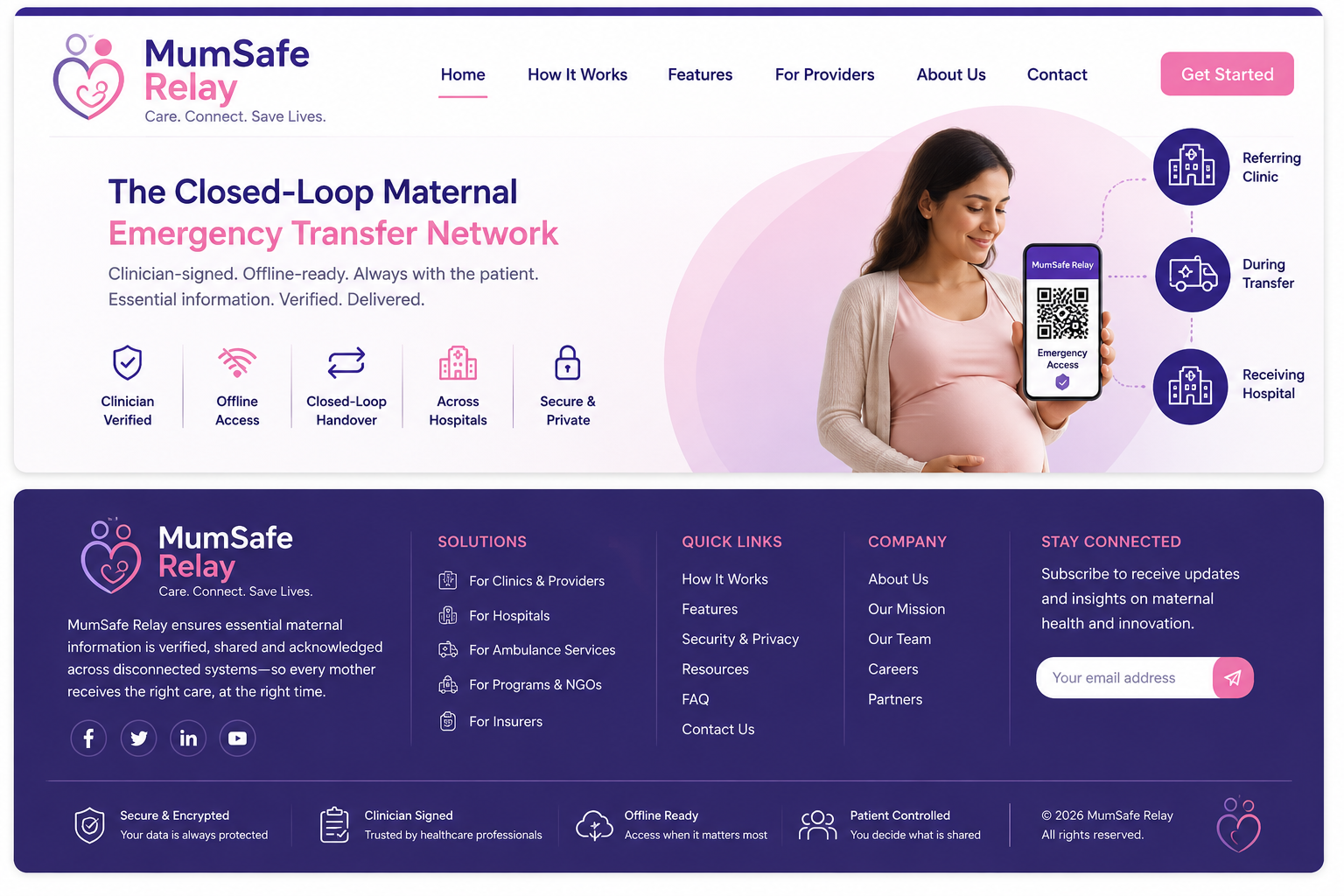
MumSafe Relay: The Closed-Loop Maternal Emergency Transfer Network
MumSafe Relay ensures that when a pregnant patient is transferred between healthcare facilities, her essential clinical information reaches a capable receiving team, is acknowledged before arrival and remains verifiable even when hospital systems or internet connections fail.
Posted by Dr Bushra Tariq
MumSafe Relay
The Closed-Loop Maternal Emergency Transfer Network
One-Line Pitch
MumSafe Relay ensures that when a pregnant patient is transferred between healthcare facilities, her essential clinical information reaches a capable receiving team, is acknowledged before arrival and remains verifiable even when hospital systems or internet connections fail.
The Problem Is Not Merely Missing Records
During an obstetric emergency, a referring clinic may send a patient to another hospital with a handwritten note, incomplete reports or information communicated through an informal phone call.
The receiving team may not know:
- Why the patient was referred
- Which clinical risks are present
- Whether the available information was clinician-verified
- Whether the patient has a previous caesarean section
- Whether she has placenta previa, hypertension or diabetes
- Which medicines or allergies affect emergency treatment
- Whether the receiving facility has acknowledged the referral
- Whether the patient reached the intended hospital
- Whether the original clinical information changed during transfer
A digital record alone does not close this gap.
The real failure is an incomplete handover between the referring provider, the patient, the transport team and the receiving hospital.
MumSafe Relay is designed to close that loop.
The Solution
MumSafe Relay creates a secure, clinician-signed Maternal Emergency Capsule for every urgent referral.
The capsule contains the minimum information required for a receiving maternity team to understand the case quickly.
It can be:
- Sent directly to the receiving facility
- Carried by the patient through a QR or NFC credential
- Displayed offline on the patient’s device
- Printed as a compact emergency handover
- Verified by the receiving healthcare professional
- Acknowledged before or during patient transfer
The system records the complete referral chain:
- Who initiated the referral
- Why the patient was referred
- Which information was clinically verified
- Which facility was selected
- Whether the receiving facility acknowledged the case
- When the patient departed
- When the patient arrived
- Whether the handover was completed
- Which information was missing or outdated
The result is not merely a portable record.
It is a closed-loop maternal emergency transfer workflow.
The Technological Leap
1. Clinician-Signed Maternal Emergency Capsule
Each critical data field has its own source, verification status and timestamp.
The receiving healthcare professional can distinguish between:
- Patient-reported information
- Clinician-entered information
- Laboratory-confirmed information
- Information extracted from a document
- Expired or outdated information
- Information that has not yet been verified
This provides field-level clinical provenance rather than treating an entire record as equally reliable.
2. Offline Verification
A limited, encrypted emergency capsule can remain available on the patient’s device or physical credential.
The receiving team can review the minimum emergency dataset even when:
- Internet connectivity is unavailable
- The original clinic is closed
- Hospital systems cannot communicate
- The patient cannot access her account
- The patient is unconscious or distressed
When connectivity returns, the system checks whether a newer version exists.
3. Receiving-Facility Acknowledgement
The receiving facility can acknowledge:
- Referral received
- Clinical summary reviewed
- Facility selected by the referring clinician
- Estimated arrival recorded
- Receiving team notified
MumSafe Relay does not autonomously diagnose the patient or choose the hospital.
It gives clinicians a structured method for coordinating and confirming the transfer.
4. Capability-Aware Referral Directory
Participating facilities maintain a verified capability profile covering services such as:
- Twenty-four-hour maternity reception
- Emergency caesarean capability
- Operating theatre access
- Blood-bank availability
- Neonatal support
- Intensive-care support
- Specialist obstetric coverage
The referring clinician remains responsible for the referral decision.
The directory reduces time spent calling multiple facilities to confirm basic service availability.
5. Transfer Completion Loop
The receiving team confirms patient arrival and handover completion.
If the expected acknowledgement or arrival confirmation does not occur, the referring team sees that the transfer remains incomplete and can follow up.
6. Continuity Gap Report
After the transfer, the system identifies operational gaps such as:
- Missing blood group
- Unverified allergy information
- Outdated ultrasound findings
- Referral not acknowledged
- Arrival not confirmed
- Excessive handover delay
- Important clinical field added after departure
These reports can help participating organisations improve referral quality without exposing unnecessary patient information.
Why Existing Alternatives Do Not Solve the Complete Problem
Hospital Electronic Records
They can contain detailed clinical information but are commonly limited to the organisation or network operating them.
Digital Maternity Records
They help patients and clinicians access pregnancy information but do not necessarily provide a complete cross-facility referral acknowledgement workflow.
Health-Passport Applications
They make information portable but may not show field-level clinical verification or confirm that a receiving team has accepted the handover.
Messaging Applications and Phone Calls
They are familiar and immediate but produce fragmented, unstructured and difficult-to-audit communication.
Paper Referral Notes
They are inexpensive and portable but can be incomplete, unclear, lost or separated from supporting reports.
MumSafe Relay
MumSafe Relay combines:
- Maternal emergency data
- Clinician verification
- Field-level provenance
- Offline access
- Receiving-facility acknowledgement
- Transfer tracking
- Structured referral handover
- Arrival confirmation
- Quality-gap reporting
- A no-integration starting model
The defensible innovation is not the QR code.
It is the verified, closed-loop transfer protocol surrounding it.
Who Buys It Today?
The initial customer is not the pregnant patient.
The initial paying customer is an independent maternity clinic that regularly refers patients to hospitals it does not control.
These clinics need a better way to:
- Produce professional referrals
- Reduce incomplete handovers
- Know whether referrals were received
- Maintain continuity with their patients
- Document the referral timeline
- Demonstrate safer operating procedures
- Reduce administrative follow-up
- Strengthen relationships with referral hospitals
Secondary customers include:
- Maternity hospitals
- Ambulance providers
- Hospital groups
- Maternal-health programmes
- Insurance providers
- Humanitarian organisations
- Government referral networks
Patient access to the emergency credential remains free.
Initial Beachhead Market
The initial launch area will be Islamabad and Rawalpindi.
The first target segment is independent obstetric and maternity clinics that refer urgent or high-risk patients to external hospitals.
The project will not initially attempt to integrate every hospital or serve an entire national healthcare system.
The first network will consist of:
- Three referring maternity clinics
- One receiving hospital
- Approximately 150 enrolled pregnancies
- A limited group of clinicians and referral coordinators
This controlled network is large enough to test the workflow while remaining practical to manage.
Revenue Model
Clinic Subscription
Proposed early pricing:
- PKR 15,000 per clinic per month; or
- PKR 300 per active pregnancy record
The pricing model will be tested during pilot interviews.
Clinic subscription features include:
- Clinician verification
- Maternal Emergency Capsule generation
- Referral handover creation
- Receiving-facility acknowledgement
- Patient QR credentials
- Transfer tracking
- Audit history
- Clinic performance reports
- Team accounts
Hospital Subscription
Receiving hospitals can subscribe for:
- Referral dashboards
- Incoming-case alerts
- Department routing
- Staff accounts
- Referral analytics
- Institutional reporting
- Integration capabilities
Programme Licensing
NGOs, insurers and government programmes can fund deployments for specific regions or patient populations.
Why Customers Would Pay Instead of Using WhatsApp or Paper
MumSafe Relay does not compete by being another communication channel.
It provides features that informal communication cannot reliably provide:
- Structured minimum emergency data
- Identity and issuer verification
- Visible information timestamps
- Acknowledgement records
- Arrival confirmation
- Controlled patient consent
- Standardised handovers
- Searchable transfer history
- Organisational quality reports
The clinic is paying for a documented referral workflow, not merely for message delivery.
Cost Efficiency
The first version is designed to function without replacing existing hospital software.
Participating organisations need:
- A web browser
- An authorised account
- A smartphone or computer
- Optional printed QR cards
No specialised scanner or new clinical hardware is required.
Formal electronic-health-record integration is a later expansion rather than a condition of initial adoption.
Current Development Status
Completed pre-development assets include:
- Product identity
- Patient application mockup
- Clinician dashboard mockup
- Emergency-card design
- Maternal emergency dataset structure
- Referral workflow
- Verification model
- Pilot framework
- Revenue assumptions
- Privacy and safety framework
The first functional prototype will demonstrate:
- Patient registration
- Clinician verification
- Maternal Emergency Capsule generation
- QR access
- Offline emergency display
- Referral transmission
- Receiving-team acknowledgement
- Arrival confirmation
- Transfer completion report
The project should be classified as “Building” only after this workflow is functioning interactively.
Pilot Plan
Pilot Participants
- Three maternity clinics
- One receiving hospital
- Fifteen healthcare professionals
- Approximately 150 pregnant patients
Pilot Duration
Eight to twelve weeks.
Success Criteria
- Essential emergency summary retrieved within 30 seconds
- More than 95% completion of required maternal fields
- Source and date visible for every critical clinical field
- More than 90% of digital referrals acknowledged
- More than 80% clinician satisfaction
- More than 80% patient willingness to continue
- Measurable reduction in missing referral information
- No confirmed unauthorised access incidents
- Clear evidence that clinics would continue using the platform after the pilot
These are proposed targets and not previously achieved claims.
Safety Model
MumSafe Relay is a communication and coordination platform.
It does not:
- Diagnose the patient
- Recommend treatment
- Automatically select the hospital
- Replace emergency clinical assessment
- Guarantee facility availability
- Override the referring clinician
- Make autonomous medical decisions
Safety controls include:
- Minimum necessary disclosure
- Patient consent
- Role-based access
- Clinician-verification labels
- Visible data timestamps
- Expiry warnings
- Access logging
- Encryption
- Revocable credentials
- Human confirmation of imported information
- Clear emergency disclaimers
- Regional legal and privacy assessment
Artificial intelligence may assist with structuring uploaded documents, but AI-extracted information cannot become clinician-verified until reviewed by an authorised healthcare professional.
Why It Will Work
The MVP relies mainly on established and buildable components:
- Secure web applications
- Structured clinical forms
- QR and NFC credentials
- Digital signatures
- Local encrypted storage
- Browser-based verification
- Notifications
- Audit logs
- Role-based accounts
- Printable summaries
The first version does not depend on advanced artificial intelligence, national infrastructure or universal hospital integration.
If the live network is temporarily unavailable, the patient still retains a limited emergency summary and printable handover.
Defensibility
MumSafe Relay’s long-term advantage will come from:
- A clinically validated maternal emergency dataset
- A trusted network of verified healthcare issuers
- A verified facility-capability directory
- Closed-loop referral workflows
- Provider relationships
- Real-world transfer-performance data
- Institutional reporting
- Local language support
- Security architecture
- Regional regulatory experience
- Integration with participating healthcare organisations
A competitor can copy a QR card.
It is significantly harder to reproduce a trusted referral network, healthcare-provider relationships, verified facility data and accumulated handover evidence.
Proposed Initial Funding
The proposed initial requirement is USD 25,000 for prototype completion and a controlled clinical pilot.
Proposed allocation:
- 35% software engineering
- 15% cybersecurity and technical testing
- 15% clinical workflow and interface development
- 10% legal and privacy assessment
- 10% pilot implementation
- 10% research and outcome measurement
- 5% contingency
Funding would be released against milestones:
Milestone 1
Working clinician-verification and QR prototype.
Milestone 2
Closed-loop referral and acknowledgement demonstration.
Milestone 3
Clinic and hospital pilot onboarding.
Milestone 4
Pilot completion and measured outcome report.
Founder Advantage
MumSafe Relay is led by Dr Bushra Tariq, a medical doctor with obstetrics and gynaecology experience.
The concept is grounded in the practical realities of pregnancy referrals, fragmented documentation, emergency communication and continuity of care.
The project is seeking collaborators in:
- Full-stack development
- Mobile development
- Cybersecurity
- Health informatics
- UI and UX design
- Maternal-health research
- Hospital partnerships
- Healthcare regulation
- Commercial development
Vision
No pregnant patient should be transferred into an information void.
MumSafe Relay aims to ensure that the correct information reaches the correct maternity team, is acknowledged before arrival and remains accessible when normal healthcare systems fail.
Roles
- Front End Dev
- Coder
- UI/ UX
- ios / Android
Building this (0)
No one yet. Be the first to join.
Build log (0)
No updates yet.
Idea appraisal
An automated appraisal by builtonideas.com — guidance only.
Appraisal for: MumSafe Relay: The Closed-Loop Maternal Emergency Transfer Network · by Dr Bushra Tariq
Appraiser: builtonideas.com · Jun 17, 2026
Appraisal score
MumSafe Relay addresses a critical and urgent gap in maternal emergency care by providing a robust, closed-loop transfer network. Its unique features, such as clinician-signed capsules, offline verification, and a capability-aware directory, offer a significant leap beyond existing solutions, promising substantial improvements in patient safety and care coordination. While the technological approach is sound, the implementation and integration into diverse healthcare systems will be key challenges to overcome.